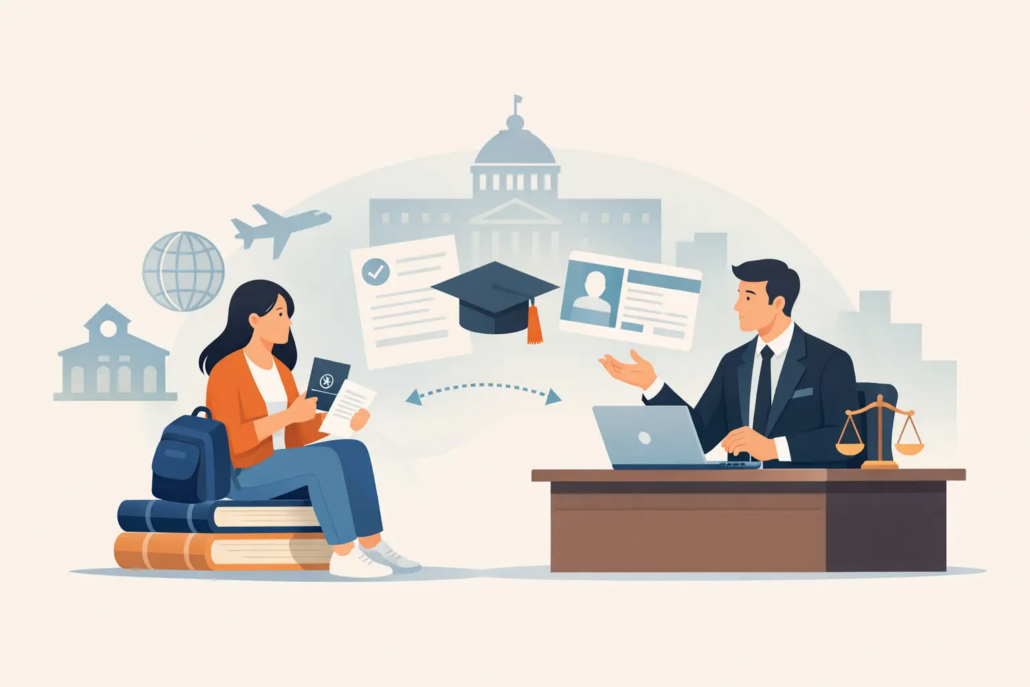
A U.S. school acceptance is a major achievement, but it is not the same as permission to enter or remain in the United States. Before classes begin, students must satisfy separate immigration requirements, document their plans clearly, and be prepared to answer questions about their education, finances, and future. A student visa attorney can help identify problems early, build a reliable strategy, and reduce avoidable delays at a point when one missing document or inconsistent answer can disrupt an entire academic term.
For students from Canada, the process may look different from the process for students who need a visa stamp at a U.S. consulate. For students with prior U.S. immigration history, a change of status request or a past overstay may create additional concerns. The right approach depends on the student’s facts, the academic program, and the timing.
What a Student Visa Attorney Helps You Evaluate
Most full-time academic students attend the United States in F-1 status. Students participating in an approved exchange program may need J-1 status, while certain vocational or nonacademic programs use M-1 status. Choosing the correct category matters because each option has different rules for dependents, employment, program changes, and future immigration planning.
An attorney can review the purpose of the program rather than simply relying on the school’s label. For example, a student entering a degree program may be a strong fit for F-1 status, while someone attending through a government-sponsored or designated exchange program may need to consider J-1 requirements. A student who hopes to gain practical training after graduation should also understand how the visa category affects available work authorization.
Legal guidance is especially useful when study is only one part of a larger family or professional plan. A student may be married to a U.S. citizen, have a pending family-based immigration case, own a business abroad, or expect to pursue employment in the United States after graduation. None of these facts automatically prevents a student visa approval, but they can affect how the application should be assessed and presented.
The School’s Role and the Government’s Role
A school that is authorized to enroll international students can issue the Form I-20 for F-1 or M-1 students. Exchange visitors generally receive Form DS-2019. These documents are essential, but they do not guarantee admission to the United States.
The U.S. Department of State decides whether to issue a visa where a visa is required. U.S. Customs and Border Protection then decides whether to admit a traveler at the port of entry. Students must also maintain their status after arrival by following enrollment, reporting, employment, and travel rules. A legal review should account for the full process, not just the consular appointment.
Preparing a Credible Student Visa Application
Student visa applications require more than a completed form. Consular officers look at whether the student is genuinely prepared for the proposed course of study, can pay for the program and living expenses, and qualifies under the applicable immigration rules.
A student visa attorney can help organize evidence so it tells a clear, consistent story. That may include admission records, academic transcripts, proof of financial support, scholarship information, bank records, sponsor documentation, and a practical explanation of why the chosen program fits the student’s educational or career path.
Financial evidence deserves careful attention. A large recent deposit without an explanation can raise questions. A sponsor’s letter may be less persuasive if it is not supported by evidence of income, savings, or a genuine relationship to the student. Likewise, a student who relies on future U.S. employment to pay tuition may face difficulty because student employment is restricted and generally cannot be the primary funding plan.
The application must also align across all documents. The school form, DS-160 application, financial records, and interview answers should not conflict about the program, source of funds, intended start date, or prior travel history. Small inconsistencies are not always fatal, but they can lead to delays, requests for additional information, or a finding that the applicant has not established eligibility.
Addressing Intent and Section 214(b)
Many student visa applicants are concerned about proving they will return home after their studies. This concern often relates to Section 214(b) of the Immigration and Nationality Act, which generally presumes that a nonimmigrant visa applicant intends to immigrate unless the applicant shows eligibility for temporary status.
There is no single document that guarantees approval. Strong ties can be demonstrated through family responsibilities, a career path, professional prospects, property, financial commitments, or other circumstances outside the United States. What matters is whether the overall case supports a credible temporary purpose.
Students should not invent plans or exaggerate connections to satisfy an interview question. Misrepresentation can have serious and long-lasting immigration consequences. Instead, the focus should be on presenting truthful facts in a direct way: why this program is needed, how it will be funded, and what the student reasonably expects to do after completing it.
An attorney can be particularly valuable where the student’s circumstances are more complex. Prior visa refusals, a pending immigrant petition, close U.S. family relationships, previous status violations, arrests, removal proceedings, or discrepancies in earlier applications all require careful review before a new application is filed.
When Timing Creates Risk
A late decision to study in the United States can create pressure, but rushing does not solve immigration issues. Students should allow time for school processing, SEVIS fee payment, visa scheduling, possible administrative processing, and travel planning. Visa appointment availability varies by country and can change without much notice.
Students already in the United States face a separate timing question: should they apply for a change of status through U.S. Citizenship and Immigration Services, or leave the country and apply for a visa abroad? The answer depends on the person’s current status, travel needs, program start date, and immigration history.
A change of status can avoid immediate international travel, but processing delays may interfere with a planned start date. Consular processing may be faster in some circumstances, but it carries the risk of a visa refusal or additional administrative review outside the United States. A student should understand these trade-offs before choosing a path.
Canadian citizens generally do not need an F-1 visa stamp to seek entry to the United States, but they still need the proper school documentation, SEVIS compliance, and eligibility for student status at the border. This distinction is often misunderstood. Visa-exempt travel does not mean immigration requirements disappear.
Maintaining Status After You Arrive
Obtaining F-1 or J-1 status is only the beginning. Students must continue to follow the rules tied to their category. For F-1 students, that commonly includes maintaining a full course load, keeping a valid passport, reporting changes through the designated school official, and obtaining authorization before accepting employment.
Unauthorized work can place a student’s immigration status at risk. Even work that seems informal, remote, unpaid, or connected to a family business may require review before it begins. Curricular Practical Training, Optional Practical Training, on-campus employment, and other opportunities have specific requirements and deadlines.
A student may also need guidance if circumstances change. A leave of absence, academic suspension, transfer to another school, reduced course load, expiration of status, or change in family circumstances can affect eligibility. Waiting until after a status violation occurs may limit available options.
Situations That Call for Legal Guidance
Not every student needs an attorney for a straightforward application. A student with a clear academic plan, reliable funding, no prior immigration issues, and proper school support may be able to complete the process independently. Still, legal advice can be worthwhile when the consequences of a delay or denial are significant.
Consider speaking with a student visa attorney before filing when you have a prior refusal, a past overstay, an arrest or criminal charge, a pending green card matter, prior work without authorization, questions about changing status, or uncertainty about supporting a spouse or child. Legal guidance can also be useful for students moving between Canada and the United States whose education, employment, and family plans cross the border.
The Bobb Law Firm PLLC helps individuals and families approach immigration matters with practical planning and clear next steps. A timely review of your documents and immigration history can help you move forward with a plan that supports your education without overlooking the legal issues that may affect it.